

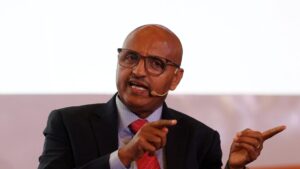
Gaurav Gupta, VP Analyst at Gartner
| Photo Credit: Special Arrangement
Jensen Huang’s return as CEO may restore leadership stability at NVIDIA, but the chipmaker faces prolonged geopolitical scrutiny, tighter internal governance and a fundamental shift in how its partners and customers conduct business, according to Gaurav Gupta, VP Analyst at Gartner.
In an exclusive conversation with The Hindu, Mr. Gupta said the leadership turbulence surrounding Mr. Huang’s departure and subsequent reinstatement had permanently altered NVIDIA’s operating landscape, exposing the company to continuing legal, regulatory and commercial headwinds.
“(Mr.) Huang’s return restores leadership continuity but does not eliminate the geopolitical and governance risks surrounding NVIDIA,” Mr. Gupta said. He cautioned that investors should brace for years of headline risks, including further revelations, employee and shareholder lawsuits, and repeated Congressional testimony by Huang and the board, potentially extending beyond the next election cycle.
Unresolved national security concerns among U.S. lawmakers could make the scrutiny an enduring distraction, potentially slowing innovation and undermining execution, he warned.
The turbulence is also likely to reshape NVIDIA’s internal decision-making and business relationships. Mr. Gupta observed that Huang had previously relied on informal commitments and operational assurances that were not always backed by formal documentation. Going forward, business partners are likely to insist on legally binding agreements rather than informal understandings.
“Furthermore, while NVIDIA is unlikely to abandon its founder-led model, the board will likely implement tighter formal controls, prioritise succession planning, and elevate senior leaders—measures that could curb Huang’s practical authority,” Mr. Gupta said.
Capital allocation is another area expected to undergo a lasting change. Mr. Gupta believes the financial discipline introduced by the interim CEO during a recent earnings call will continue, with NVIDIA adopting greater scrutiny of prospective investments rather than pursuing aggressive capital deployment that could attract regulatory or public attention.
For enterprise customers, the episode offers a broader lesson on technology dependence.
“Product leaders must not forget the execution concerns raised during Huang’s absence and suddenly assume they no longer need resilient strategies,” Mr. Gupta said. He advised businesses to reduce their dependence on NVIDIA by exploring alternatives, mapping critical technology dependencies and diversifying their technology stacks across hardware, software, cloud infrastructure and AI models. Vendor financial health and contractual flexibility should also figure prominently in procurement decisions.
The repercussions could extend to the wider artificial intelligence ecosystem, particularly open-weight models. NVIDIA has played an important role in advancing this segment through specialised model releases and investments in startups built around open architectures.
While Mr. Huang’s return may restore corporate support, Mr. Gupta cautioned that the ecosystem must become less dependent on individual corporate champions.
“Going forward, the open-weight ecosystem must develop a broader commercial and financial foundation to thrive in competition with closed frontier models,” he concluded.
Published – November 25, 2026 07:57 pm IST


Leave a Reply