
Among the many visuals of police brutality that streamed on our devices during the protests in New Delhi, the most shocking were those that showed random individuals raining lathis on the protesters. Many layers of violence are embedded in them: that they are civilians, that the police watch passively, that they seem to be using police lathis. While criticising any excessive use of force by the police, we remain aware of Max Weber’s premise that a founding principle of statehood is the monopoly claimed on violence, but what makes these images so disturbing is knowing that the state has now invited into its monopoly non-state actors. Suddenly, you see the embryo of a police state forming in front of your eyes, where behind the regular police are shadowy secret players, unaccountable to anyone because unidentified, but with abundant leeway to do harm.
Post-Independence India faithfully modelled its police on a law enacted in 1861, when the British deliberately eschewed their own Peelian model of “policing by consent” in favour of what they had in Ireland, a quasi-military force designed to inform, suppress, punish. From inception, therefore, the police have seen the citizen as the enemy, and their role as protecting the rulers from the people. Blaming the Raj, however, is long past its best-by date. Dozens of committees have come and gone, outlining reforms and suggestions to remove the police from direct executive supervision, each duly buried because governments are loath to lose their dirty tricks departments. The most egregious practices of midnight snatches and prison torture might have declined, but we are far from policing by consent or indeed any humane policing model. To claim that violence or communalism persist in the police because they persist in society is a stretch—rigorous training and culturisation knock most of it off in the armed forces, and it can be done in the police too. Rather, if we recognise the return of communalism to the armed forces over the past decade, we find the bigger clue to why police brutality is also back in the news. More importantly, why the police now swagger with a new impunity.
Where once complaints of excess resulted in regret and inquiries, we are now seeing an astonishing turnaround. After multiple videos and complaints emerged of their conduct during the Delhi protests, the police simply counter-accused the public of harassment and paraded testimonials from wives and families. ACP Vivek Bhagat, accused of improperly touching women journalists, filed a counter-complaint. When ACP Manasvi Vashishtha was transferred after a scuffle where he brandished a revolver, he led a protest demanding his “rights”. Vashishtha has since been suspended, but we are seeing how far this deeply flawed politics of “balancing”, which equates armed police with unarmed protesters, can play out with political and public encouragement. It seems to placidly accept that to fight crime, the state has to become a criminal. The Uttar Pradesh Chief Minister flaunts Operation Langda, where the police shoot criminals in the leg as they try to “escape”, claiming it reduces crime rates. The Allahabad High Court slammed the practice, saying only courts have the jurisdiction to punish, but the maiming continues. As primitive notions of vengeance as justice make a comeback, we are seeing unleashed an orgy of brutality where the lines between criminal and law enforcer, criminal and civilian are being smudged.
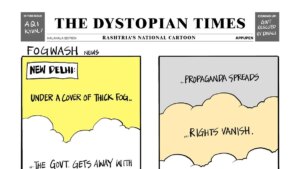
The fuzziness is deliberate—the emerging police state I mentioned is no exaggeration: consider the Sangh Parivar’s footmen posted in registration offices to spot notices of intercommunal marriages. Or the WhatsApp networks that track trucks carrying cattle. Or the mass filing of Form 7s to delete Muslim voters. Civilians turning into patrolling vigilantes, filing gratuitous FIRs that the police take up with alacrity in an extraordinary collusion that has seen social harmony and the larger public good subordinated to the interests of state touts. On the back page of this issue, Appupen’s Dystopian Times shows the protests that are alight in multiple corners of the country. These are the ordinary people who are beginning to see a pattern, ordinary people raging against the state-corporate nexus, the state-RSS nexus, the state-judiciary nexus, the state-Election Commission nexus, the state-media nexus, and the state-police nexus, each a strand in a tapestry whose form is yet obscure, but whose intents are not.
Also Read | A fortified Delhi and a growth story with a hole in the jobs market
Also Read | Modi opens war on the people, and the Supreme Court looks on


Leave a Reply