

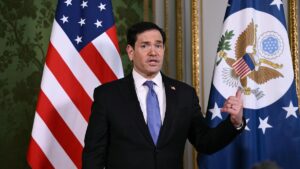
File photo of Canada Prime Minister Mark Carney.
| Photo Credit: Reuters
Canadian Prime Minister Mark Carney said on Tuesday (November 10, 2026) that his government has not made a decision about lifting its decade-long moratorium on offshore oil and gas exploration in the Arctic, a move that some Northern leaders have advocated for as a way to increase the region’s economic self-sufficiency.
Last week’s federal budget contained a reference to C$11 million ($7.79 million) in funding over four years to “support the governance and oversight of offshore oil and gas activities in the Arctic Ocean.” Mr. Carney told reporters in Montreal the budget item represents “capacity funding” for Inuit leadership, with whom the federal government has agreed to jointly manage natural resources in the North.
“It is absolutely not, in any way, shape or form, a decision about lifting the moratorium,” Mr. Carney said. “It is respectful engagement with that self-government.”
“Any possible discussion with respect to the future of the moratorium would respect existing agreements, Inuit and territorial self-government, and uphold Canada’s strong environmental standards,” Canada’s Minister of Northern and Arctic Affairs Rebecca Chartrand said in an emailed statement.
Mr. Carney has been seeking to grow Canada’s energy sector in order to boost the country’s economy in the face of U.S. tariffs. He has faced criticism from environmentalists for the dropping or easing of a range of climate regulations in pursuit of economic growth.
The Toronto Star reported on Monday (November 9, 2026) that Mr. Carney’s government is considering lifting the ban on oil and gas activities in the Arctic, quoting a Department of Finance official. The Finance Department referred Reuters to Crown-Indigenous Relations and Northern Affairs Canada, which did not immediately respond to a request for comment.
Canada’s moratorium on Arctic offshore oil and gas exploration has been in place since 2016, when then-Prime Minister Justin Trudeau and then-U.S. President Barack Obama agreed to impose it to protect the region’s fragile marine ecosystem from the risk of oil spills.
U.S. President Donald Trump later reopened parts of the Arctic to oil and gas drilling, but the Canadian moratorium remained in place. The Canadian policy, which is set to expire in 2028, is reviewed every five years.
Canada’s Arctic region possesses significant undeveloped oil and gas reserves, and some Northern leaders have been calling for the area to be opened up to drilling.
Nunavut Premier John Main told the National Observer media outlet last week he wants to see the territory’s fossil fuel industry take off, so that Canada’s north can become more economically self-sufficient.
In 2023, the Northwest Territories, Yukon and Inuvialuit Regional Corporation, which represents Inuit communities in the Western Arctic, signed the Western Arctic-Tariuq Accord with the Canadian government. The accord stated that northern residents should have more say in how their resources are developed, and laid out an agreement for the management, regulation, and revenue-sharing from potential fossil fuel development in the Arctic.
Canada’s Arctic region is an ecologically sensitive area, with its coastlines vital habitat for fish, migratory birds, marine mammals and polar bears.
Published – November 11, 2026 07:31 am IST


Leave a Reply