
A series of protests across prominent universities appears to indicate a new wave of awareness and dissatisfaction among students, over and above the movement generated by the Cockroach Janta Party. Despite the law allowing student unions, many universities informally discourage them. That is now backfiring, as students get more vocal about their rights.
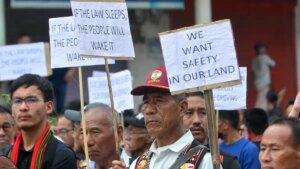
Students at Jamia Millia Islamia (JMI) protested for 18 days to demand that the Central university restore the students’ union and hold elections, overdue for 20 years. Finally, they called off their protest on October 30 after the administration agreed to their demands and set a timeline to constitute the students’ union and hold elections.
The university administration has set May 15, 2027, as the deadline to approve and implement the JMI Students’ Union Constitution. And, according to an order issued by university Registrar Mahtab Alam Rizi, elections will be held within six weeks of the start of the academic session next year.
After the agreement, a historic moment for the Jamia Students’ Union, the students held a victory march on campus to celebrate. Nasir Khuehami, a doctoral scholar at JMI, said in a post on X: “The government has bowed to the power of student unity.” He added that the students had stood their ground, defended their democratic rights, and refused to back down.
The Congress party supported the students, with Pawan Khera, who heads its media and publicity wing, posting on X: “The university has effectively been shut down until January 13, 78 days from now. For what crime? For students demanding their fundamental constitutional right under Article 19(1)(c) to form associations and unions, including an elected student union. This is what the BJP’s fear of dissent looks like. This is what its hostility towards young people looks like. When students demand their democratic rights, the response is not dialogue but repression.”
Earlier, with no resolution in sight and the stalemate continuing, a shadow fell over the Central university’s foundation day celebrations on October 29, with the deadline remaining a key point of contention. Jamia also cancelled Talimi Mela, its annual cultural festival. After the agreement, however, the university organised low-key celebrations.
The Jamia protest saw at least five students going on hunger strike, including Ebin Basil, who fasted from October 12, the first day of the protest, and Rehan Khan, who fasted for more than two weeks. On October 26, the Chief Proctor ordered Rehan Khan to vacate the protest site, claiming it was hampering the political science and economics departments.
Widespread support for Jamia students
Moreover, Mohammad Faizan, president of the National Students’ Union of India (NSUI) campus unit, and Zeeshan Khan, former NSUI social media coordinator, were remanded to judicial custody in Tihar Jail for three days on October 29, and subsequently released on bail.
On October 25, the police registered an FIR against three MPs—Imran Masood and Imran Pratapgarhi of the Congress and Mohibbullah Nadvi of the Samjawadi Party—who were accused of trying to enter the college by breaking locks and scaling the walls, on October 21 and October 24, respectively. Masood and Nadvi were detained and later released.
Subsequently, after reported large-scale vandalism on the campus on the night of October 27, the university was locked down and a heavy deployment of security forces put in place. Following this, the university administration moved to hold its end-semester examinations online. It also extended online teaching and announced winter holidays from December 25, 2026, to January 12 next year. However, with the issue resolved, the university said it would resume offline classes from November 10.
Students had earlier rejected the university’s October 26 promise to hold elections 15 days after it approved the Students’ Union Constitution. They wanted a clear deadline, such as approving the constitution by December 20, followed by elections within 15 days.
A group of students wrote to Vice Chancellor Mazhar Ashraf on October 26 in this regard. The day before, the students had submitted a letter to the administration seeking a written commitment before they ended their protest. The university assured the students it would revoke suspensions and cancel the show-cause notices issued to students, as well as inquire into the actions of security staff during the protest.
The students got support from elsewhere too. On October 26, several alumni, members of JMI’s founding families, artists, and concerned citizens associated with JMI, under the banner of Jamia Collective, announced that they too would join the students and student organisations “in solidarity” for the restoration of the students’ union. Some Jamia Collective representatives addressed a press conference to discuss the movement, demand democratic representation on campus, and raise concerns over the removal of students on a hunger strike and disciplinary action against protesters.
Jamia Collective also called on the university administration to protect students’ democratic rights, end punitive action against protesters, and provide clear, time-bound commitments to restore an elected students’ union. It took several meetings between students and administration before the stalemate ended, with an added bone of contention being the university’s insistence on a public apology from students for defamatory statements and posts made against the administration during the protest, which the students refused to give.
In this season of student protests globally, the Jamia affair was not an isolated one. What began as a complaint in Aligarh Muslim University (AMU) by women students over insects found in the mess food and poor sanitation soon grew into a broader protest that lasted from September 21 to October 10, demanding the restoration of the Aligarh Muslim University Students’ Union (AMUSU).

A candidate contesting the Aligarh Muslim University Students’ Union election with supporters during a motorcycle rally on October 28, 2026. The election was held on November 5, after a gap of eight years.
| Photo Credit:
SHASHI SHEKHAR KASHYAP
Yasir Fahad, an MA Urdu student, who became the face of the protest, sat on hunger strike. The last student body election at AMU was held in 2018-19. The AMU administration also had to reach an agreement with the protesting students on the issue by promising to hold union elections, which it did on November 5. Former Jamia Vice Chancellor Najeeb Jung, later Lieutenant Governor of Delhi, to add his voice to the students’, said that with AMU announcing elections, Jamia students too should be able to have an election soon.
The Jamia and AMU protests were followed by Jawaharlal Nehru University, where members of the JNU Students’ Union (JNUSU) also went on a hunger strike for 17 days, demanding greater involvement of the elected student body in university affairs and raising allegations of corruption in university recruitment. Their hunger strike ended on October 19. Students at Ambedkar University Delhi (AUD) protested for 17 days, demanding better basic amenities and freedom of movement on campus.
Students restless worldwide
The series of protests is symptomatic of the student restlessness across the world. In each instance, the administrations first tried to clamp down on the protests and only gave in after measures such as hunger strikes were undertaken. The instinctive response to shut down dissent reveals the challenges to student politics in the country. Despite agreeing to the demands finally, university administrations often insist on punitive action. In JNU, the protests ended on October 19, but five students were rusticated. Likewise, 11 protesting AUD students were suspended.
In May 2006, a committee headed by former Chief Election Commissioner J.M. Lyngdoh submitted a report laying down that annual elections for student bodies were to be held in colleges and universtities and that the entire process, from nominations to results (including campaigning), should not consume more than 10 days. The Lyngdoh Committee was set up by the Ministry of Human Resource Development after a Supreme Court direction in December 2005. On September 22, 2006, the apex court accepted the recommendations and held that colleges and universities should regulate student union elections accordingly.
Student politics cannot be wished away from campuses. They are the cradle for future leaders, where they imbibe the first ideas about democracy and governance. Whether Sitaram Yechury of the CPI(M), Arun Jaitley of the BJP, Anand Sharma and Manish Tewari of the Congress, or Governor Arif Mohammad Khan, all of them rose from student unions. The extraordinary acuity and presence of the CPI(Marxist-Leninist) Liberation’s student union president Neha Bora in recent times is unmissable.
Ajay Gudavarthy, associate professor of political science at the Centre for Political Studies, JNU, said: “India has a long tradition of student leaders making seminal contributions to both electoral politics and social activism. In Assam, the AGP [Asom Gana Parishad] emerged from a student movement and, in fact, gained political power. Student politics is a key launching pad for political careers.” Students have regularly initiated movements that have later grown much larger. Tamil Nadu’s 1965 language agitation was led by student unions, as were the anti-Mandal protests of 1990.
India is a young nation whose “demographic dividend” has come under much discussion in recent times. And, as Gudavarthy said, “students potentially represent a larger constituency because they are looking more to the future than to the past”.
Also Read | Suspensions, surveillance, and silencing: Understanding the student crackdown at Jamia Millia
Also Read | Is Jamia crackdown part of a broader pattern to suppress student activism in universities?
Leave a Reply