
The Congress-led United Progressive Alliance government enacted the Central Educational Institutions (Reservation in Admission) Act, 2006, which codified 15 per cent reservation for Scheduled Castes (SC), 7.5 per cent for Scheduled Tribes (ST), and 27 per cent for Other Backwards Classes (OBCs). The Act triggered countrywide protests by general-category and privileged-caste groups, the second nationwide agitation against reservation for subaltern castes after the 1990 anti-Mandal protests.
Started by medical students in Delhi, the protests soon drew in engineering students, doctors, and management students in several cities, under an umbrella group called Youth for Equality.
The Act applied to all central universities and institutes of national importance, such as the IITs, the IIMs, and the All India Institutes of Medical Sciences, and explicitly covered doctoral programmes. To address the protesters’ fears, the then government mandated an expansion of overall seat capacity so that the number of unreserved seats would not fall.
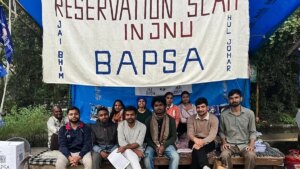
Twenty years later, students at Jawaharlal Nehru University (JNU) have been on an indefinite sit-in for three weeks, alleging discrepancies in the implementation of reservation rules in PhD admissions.
Students affiliated with the Birsa Ambedkar Phule Students’ Association (BAPSA) flagged the discrepancies. According to BAPSA, the PhD admission seat matrix for 2026-27 lists only 38 of the 53 mandated ST seats. Of the 84 programmes that released their PhD intake, 56 have not reserved a single ST seat. Its school-wise analysis found a 28.3 per cent shortfall in ST seats, with some schools reserving none.
Under the rules, a programme with seven seats must reserve one for an ST candidate. In some schools, however, 12 seats were offered but divided into 6 each for NET-JRF and NET UGC candidates, which, the students say, effectively removed the single mandated ST seat.
Across four admission rounds (2024, 2025-26 phase I and II, and 2026-27), 30 programmes offered 351 PhD seats without reserving a single one for ST candidates, according to BAPSA’s data. The figures show a similar pattern for SC seats, with an average shortfall of 3.8 per cent in the 2026-27 session.
Avichal Warke, a PhD student at JNU’s Centre for Political Studies (CPS) and a former BAPSA president, questioned the university’s claim to progressivism.
“Such claims of progressivism remain deeply contradictory to the realities of the campus. Despite its self-proclaimed progressive environment, we recently witnessed an incident of manual scavenging within our premises. Caste-based slurs continue to surface on the walls of the campus, while the administration maintains silence over these incidents. Even the prominent left student organisations have yet to extend support to our demands, so where is the progressive identity?” he asked.
According to JNU’s own annual reports over the past decade, the university has consistently fallen short of the prescribed reservation quotas for SC and ST candidates.

One of the key demands of the protesters is “No Viva Voce” until all issues are solved. They are also pushing for the implementation of the Nafey committee’s recommendations.
| Photo Credit:
By special arrangement
BAPSA is also demanding an end to weightage for the viva voce in doctoral admissions. Under the current system, the written examination carries 70 per cent and the interview 30 per cent.
In 2012, the Rajiv Bhatt Committee, which JNU itself constituted, found that candidates from subaltern castes received significantly lower viva voce marks than general-category students. Its data for 2007 to 2011 showed that marginalised students who scored well in the written examination often received disproportionately low interview marks and missed out on admission.
The Sukhadeo Thorat Committee, formed by the government of India, and the Abdul Nafey Committee both recommended reducing the weightage of viva voce marks in the overall admission score. The JNU administration has yet to implement the recommendations.
Promotions and complaints
Komal Devi, a PhD scholar at CPS and a BAPSA activist, said that assistant professors at the university also face caste-based discrimination. “Bahujan faculty members, particularly assistant professors on this campus, are not given promotions accordingly, and other faculty members, who are junior to them, get promoted,” she told Frontline.
“Assistant professors are permitted to supervise a maximum of four scholars, associate professors six, and professors eight. But when corresponding PhD vacancies remain unavailable, thereby limiting admission opportunities for students from marginalised backgrounds,” she said.
The Jawaharlal Nehru University Teachers’ Association also released a statement expressing concern about “irregularities and subversion of constitutional reservation policy in PhD admissions”. The statement pointed to a systemic disparity in faculty appointments, where ST and OBC representation among vacant teaching posts is significantly higher than among filled posts.
D.K. Lobiyal, a professor at the School of Computer & Systems Sciences, said that over the past few years the JNU administration had not shared data on student admissions with the Academic Council. “This has been happening for years and across Vice Chancellor tenures. Had the data been presented before the Academic Council, we could have spotted the discrepancies in the admission process. But given the present pattern of seat allocation, it appears that these irregularities may have existed for years, only coming to light now after students identified the discrepancies in the admission prospectus,” he said.
He added that the lack of timely promotions, and discrimination against faculty from reserved groups, had led to a significant drop in PhD seats. “Assistant professors whose promotions remain overdue miss the opportunity to supervise more scholars. If the promotions were on time, they [assistant professors] could have attained professorial positions, and generated four additional PhD seats per member. The administration is also failing to fill the reserved faculty seats and a systematic violation of constitutional provisions is happening where promotions are selectively withheld, of faculty who come from subaltern communities.”
The Students’ Federation of India filed a complaint with the National Commission for Scheduled Castes, which took cognisance and issued a notice to the university registrar seeking the relevant facts.
JNU has formed a five-member committee to examine the allegations.
Also Read | UGC equity rules are a carefully curated political gesture: Anand Teltumbde
Also Read | A disturbing pattern

Leave a Reply