

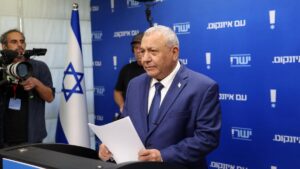
Delegations from Mr. Eisenkot’s Yashar party and Mr. Netanyahu’s Likud began their meeting at a hotel in Herzliya, near Tel Aviv, an AFP journalist on the scene said, following a first round of talks on Sunday (November 15, 2026).
| Photo Credit: Reuters
The parties of caretaker Israeli Prime Minister Benjamin Netanyahu and his rival Gadi Eisenkot launched a new round of talks on Sunday (November 22, 2026) over whether to form a coalition government, with Mr. Netanyahu’s party insisting on keeping his main policies.
Delegations from Mr. Eisenkot’s Yashar party and Mr. Netanyahu’s Likud began their meeting at a hotel in Herzliya, near Tel Aviv, an AFP journalist on the scene said, following a first round of talks on Sunday (November 15, 2026).

A former Chief of Staff of the army, Mr. Eisenkot has until December 6, 2026, to form a government, with the possibility of a 14-day extension, after the October 2026 elections failed to give either camp an absolute majority.
His 48-member bloc, which needs 61 lawmakers to reach a majority, remains divided over whether to build a coalition through an alliance with ultra-Orthodox parties, a rapprochement with Arab parties, or a national unity government with Likud.
Mr. Netanyahu is pushing for a national unity government, which could see a rotation of the premiership between the two men, a mechanism already tried in Israel.

Such an arrangement could allow him to keep his political protection against the corruption charges he faces, as well as continue to oppose the creation of an independent commission of inquiry into the security failures that preceded the Hamas attack of October 7, 2023.
But that prospect runs up against Mr. Eisenkot’s refusal to serve in a cabinet led by Mr. Netanyahu, against whom he centred his campaign. His ally, former Prime Minister Naftali Bennett, also reiterated on Saturday (November 21, 2026) his refusal to join a coalition with “Netanyahu or his bloc, under any circumstances”.
National ‘unity’?
On Saturday (November 21, 2026), Yashar presented the resumption of talks as “a genuine commitment to forming the broadest possible government”, saying Mr. Eisenkot had asked his representatives to explore all options. But Likud immediately laid down several conditions for its participation in a unity government, a formula backed by Mr. Netanyahu.
Among other things, it demands an end to “all personal attacks and incitement to hatred” targeting the outgoing Prime Minister and his government. It also called for bringing together “all the parties that support the existence of the State of Israel as the nation-state of the Jewish people”, without the participation of Arab parties. Mr. Netanyahu and his allies regularly target Arab parties, which secured a record 19 seats in the legislature and are opposed to his remaining in power.
Likud is also demanding agreement on several major policy positions, notably rejecting the creation of a Palestinian state, maintaining Israeli control over territories in Syria, Lebanon and the Gaza Strip, and a compromise on conscription of ultra-Orthodox Jews, a particularly sensitive issue in Israel.
On Friday (November 20, 2026), Mr. Eisenkot warned that he would not allow the talks to drag on, saying he was ready to submit to parliament an “emergency national government”. Although he did not spell out how, his statements suggest a two-stage plan: the swift formation of a minority government based on the core opposition parties, and then broadening it.
A minority Eisenkot government could receive support from the 19 Arab party lawmakers, but his right-wing ally Avigdor Liberman rejects working with them, and instead advocates an alliance with ultra-Orthodox Jewish parties.
Published – November 22, 2026 10:47 pm IST

Leave a Reply