
Sonia Gandhi is so much a part of us and India that it was a bit of a jolt for me to open Belonging: A Journey of Love and see her begin with her longing for Italian food in England. On page one, she gives a vivid description for her loathing of the climate and food in the UK: “I could not bear the sight, let alone the taste, of those meals.” But the universe compensated by introducing her to Rajiv Gandhi, and a great love story begins, one that brought Sonia to India and the extraordinary cycle of her life starts ticking along with the wheels of contemporary Indian history.
I picked up this book for Sonia’s take on the big moments of life as a member of the home of Indira Gandhi when she imposed the Emergency, her assassination, the 1984 bloodbath that followed, the demolition of the Babri Masjid, Rajiv Gandhi becoming Prime Minister and then the full-scale horror and grief of another assassination, Sonia’s own journey as the longest-serving president of the Congress party, and her children’s entry into politics. It’s all there, gut-wrenching, painful, also commendable: the story of a woman picking up her life and staying the course and feeling so much satisfaction in moments such as when MGNREGA was passed during the Manmohan Singh era.
But I loved this book for little details, some trivia, and insights. Who on earth knew that, when angry, Indira Gandhi would make the staff stand in corners, and that Sonia once sighted a Congressman doing so too, staring at a wall for hours! And that Rajiv would discipline Rahul and Priyanka by making them write a hundred times what they should not do. Priyanka wrote, “I will not bang doors,” and Rahul, “I will switch off the lights.”
Or that Indira used mascara on those long eyelashes for official functions, preserved her old heirloom and handloom sarees carefully, ate arhar dal daily like most people from Uttar Pradesh but loved Kashmiri Pandit food, and that during a brief jail tenure she requested Sonia to also bring food for an Australian girl incarcerated with her (who had been an accomplice of the notorious murderer Charles Sobhraj).

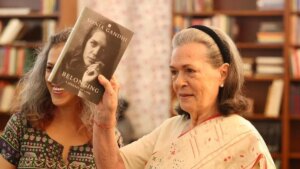
In this image posted on November 11, 2026, a glimpse of Sonia Gandhi’s memoir, Belonging: A Journey of Love.
| Photo Credit:
X.com/@INCIndia
Sonia’s portraits of Indira Gandhi sitting stiffly with foreign visitors are acutely observed. Fidel Castro seems to have broken through the barrier with Indira and years later when Rajiv became Prime Minister, chatting with him for six hours. But Indira sat silently during a lunch hosted by Queen Elizabeth, who kept up the conversation at her end while Princess Margaret’s glass was frequently and discreetly refilled. It’s a fun read in these parts. A galaxy of the great leaders of the world have little cameos when they meet Indira and later Rajiv.
The regular visitors to the Indira Gandhi household are also nicely etched. Dhirendra Brahmachari is described as a teacher of yoga and “Narad muni” known for carrying tales back and forth with “a long beard and hair dyed in what I term hysterical black, a shade too dark for nature”.
There’s Rajiv’s friend Amit who is there when Sonia first lands in India before marriage and is taken to live in the household of his parents Harivansh Rai Bachchan and Teji Bachchan. But what happened to the friendship with Amit we are never told, though; readers would have liked to know as he became a huge movie star.
Sonia’s life in India is spent as the perfect wife and daughter-in-law. Hours went adjusting to new food, language, and waiting for her husband to come home from his training and work as a pilot and later as politician and Prime Minister. She lovingly raised her children (after losing one at birth, we learn in the book). And she lived with and helped her extraordinary mother-in-law in a manner that is quintessentially traditional, until she came running out in a dressing gown and accompanied Indira’s bullet-riddled body to hospital.
When the story changes
That’s the point when the story changes. There’s an account of Sonia’s near-hysteria when Rajiv is to be quickly sworn in as Prime Minister. Sonia writes: “I felt a knife was being plunged into my heart.” She begged, saying, “They will kill you too.” Rajiv replies: “They will kill me anyway.” Six and a half years later it’s the young Priyanka who carries the news to her mother that “papa is dead’. It is still disturbing to read of Sonia’s desire to look into his face and eyes and be told of the great damage done in death to Rajiv Gandhi.
Let me confess that for all the debates raging over Sonia’s book, and the BJP plus Akali Dal attack on it, it’s the other nuanced parts about the lives of this family that I found fascinating, such as Jawaharlal Nehru’s belief that he was not a good father or husband and Sonia’s insights into Indira’s relationship with her husband Feroze Gandhi. Anyone who has followed the family would also be curious about the great rift within, which culminated in Maneka Gandhi being made to leave the household in 1982, less than two years after Sanjay Gandhi died in a plane crash.
Apparently, Indira asked her to go because of political ambitions and associations that she saw as linked to her rival’s schemes and the RSS. By then, inner-family relations had soured. After Indira’s 1977 defeat in the election held after Emergency, Sonia believes that Maneka spread rumours through journalists that she and Rajiv intended to leave the country. Maneka would apparently also curtail her son Varun Gandhi’s visits to his grandmother, and the family even went to court on this matter—with the last legal notice apparently going a few months before Indira’s assassination.
Sonia’s version of contested events such as the Emergency and the 1984 bloodbath is naturally the family version. She and Rajiv seem to have squarely blamed Sanjay Gandhi for influencing Indira towards the imposition of the Emergency. We cannot ignore that there were views that prevailed on Indira to actually lift the Emergency and conduct elections—at the cost of electoral defeat. The Congress has also frequently expressed remorse for what happened in 1984 after Indira’s assassination by her Sikh bodyguards.
Sonia did eventually choose Manmohan Singh to be Prime Minister. In the book she gives some interesting reasons for this choice: Manmohan Singh was not allied to any camp in the party and in the early 1990s introduced economic reforms. Sonia writes that because the UPA would be supported by Communist parties, “I thought Dr Manmohan Singh would assuage the doubts of many about our ability to manage and continue the policies that had begun years ago.”
This is the kind of book that can both be read non-stop because it’s very readable but will also be pored over because of who the author is. For all the politics in Sonia’s life, she is someone who actually lives through her family. The cover photograph is taken by Rajiv Gandhi, who obviously fell madly in love with the Italian girl he met in England, while the back cover picture is taken by Priyanka’s son, Raihan Vadra, and his partner, Aviva Baig, of a grandmother who took decisions that shaped our country.
Saba Naqvi is a Delhi-based journalist and author of four books who writes on politics and identity issues.
Also Read | Sonia Gandhi’s second coming as writer and critic
Also Read | Who is afraid of Sonia Gandhi?

Leave a Reply