

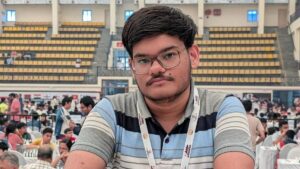
Anuj Shrivatri.
| Photo Credit: Special Arrangement
When Viswanathan Anand played Alexei Shirov in Tehran in 2000 for his first World title, he knew his time would come, if not then. Back in the latter half of the 1980s, when he was trying to become a Grandmaster (GM), he wasn’t as sure.
“I had no way of knowing if I would become a GM or not,” Anand once told this correspondent during an interview at his home in Chennai. “It took me two full years to get it.”
Anand got his final GM norm in December, 1987, from the Sakthi Finance tournament in Coimbatore. India didn’t have a GM till then. Asia only had two.
Nearly four decades later, India has a hundred Grandmasters. Anuj Shrivatri became No. 100 on the Diwali Day. He got his GM title, directly, by winning the ASEAN Plus Individual Open Chess Championship at Ozamiz City, the Philippines. He didn’t have to struggle for making the three norms and touching the FIDE rating of 2,500 Elo points, which is the usual way to become the GM, the title that matters most in chess.
India is now churning out GMs like the IPL unearths fresh talents. It is indeed remarkable that a country that had no GM till four decades ago now has 100. Only three others — Russia, the United States and Germany — are in that exclusive club. But they all have had GMs from the time the world chess governing body started awarding the titles in 1950.
Seven decades later, there are only around 2,000 GMs across the world. That gives a fair indication about India’s feat.
After Anand, India had to wait for another four years before its next GM. Dibyendu Barua, the country’s original chess prodigy, became a GM in 1991. It was only six years later that India got another GM — Pravin Thipsay.
The next generation of Indian chess players had it easier. It was after Abhijit Kunte became India’s fourth GM in 2000 that the country began to see the coveted title arriving home regularly.
Chess, thanks to Anand’s exploits as the Lightning Kid on the global stage, was becoming increasingly popular and the Indian parents were willing to invest in their children. The All India Chess Federation was conducting tournaments and coaching camps, including reputed GMs from overseas, and corporate support was also trickling in.
Rarely in Indian sport have so many things worked in such tandem.
Published – November 09, 2026 07:07 pm IST


Leave a Reply